


Hiking trails and the Camiño Miñoto Ribeiro
- Inicio
- Rutas de sendeirismo e Camiño Miñoto Ribeiro
Hiking, along routes of low or medium difficulty through well-signposted landscapes, is an attractive activity to complement others that can be enjoyed here, such as mountain biking, horse riding and horseback rides, or boat trips, for example.
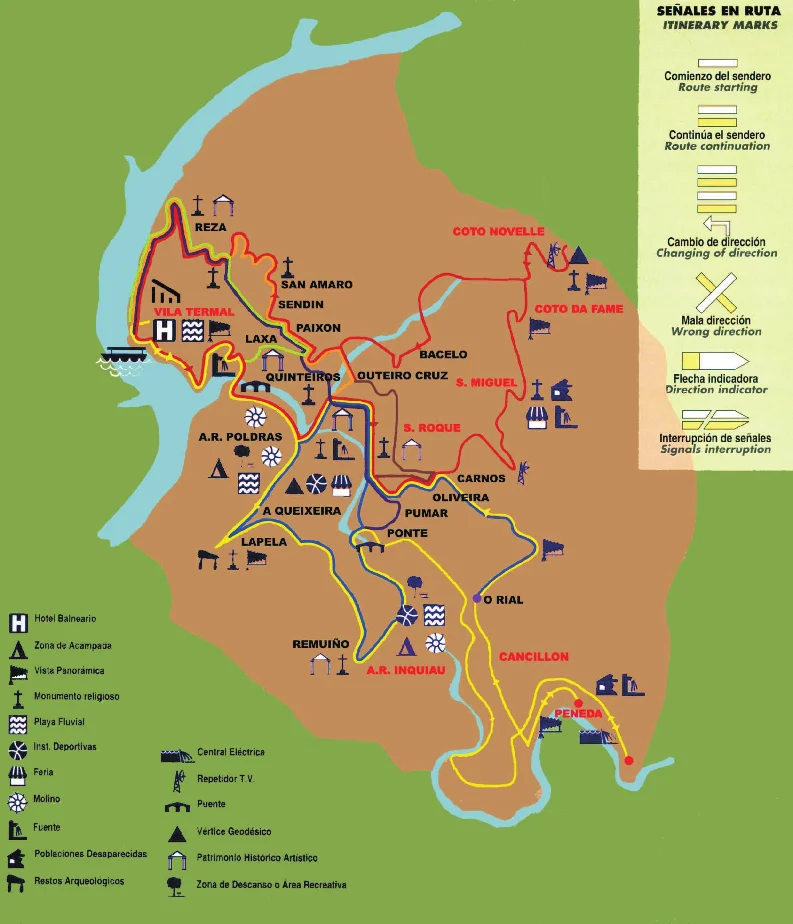
Route technical details
Rivers Route
ROUTE: Departure from Vila Termal – Chaos – Poldrás Recreational Area – Lapela – Remuiño – Ponte – Rial Peneda – Carnós – S. Roque – Outeiro Cruz – Poldras – Chaos – Vila Termal
Distance: 15.000 m. approx.
Difficulty: Medium – High.
Turn-off at Ponte
ROUTE: Via S. Roque – Outeiro-Cruz – Paixón and return to Vila Termal via Reza.
Distance: 8.600 m.
Difficulty: Medium
Mountains Routes
ROUTE: Via S. Roque – Outeiro-Cruz – Paixón and return to Vila Termal via Reza.
Distance: 13.000 m. approx
Difficulty: High
Turn-off at San Roque
ROUTE: Via Carnós – Bacelo – and return via Paixón – Sendín – San Amaro – Reza – Vila Termal
Distance: 8.000 m.
Difficulty: Medium
Turn-off at Chaos
ROUTE: Via Laxa – Quinteiros – Paixón – Sendín – San Amaro – Reza – Vila Termal
Distance: 4.000 m..
Difficulty: Low
Turn-off at Cancillón
ROUTE: Via Camós – S. Roque – Outeiro-Cruz – Poldrás – Vila Termal
Distance: 10.000 m.
Difficulty: Medium
Turn-off at Outeiro-Cruz
ROUTE: Via Bacelo – Paixón – Sendín – San Amaro – Reza – Vila Termal
Distance: 5.600 m.
Difficulty: Low
Turn-off at Ponte
ROUTE: Via Remuiño – Lapela – Poldrás – Chaos – Vila Termal
Distance: 9.500 m.
Difficulty: Medium
Nature, thermal springs and Wine: this is the CAMIÑO MIÑOTO RIBEIRO AS IT PASSES THROUGH THE CONCELLO DE A ARNOIA
The Camiño Miñoto Ribeiro is one of the oldest paths that connected the north of Portugal with the city of the Apostle Santiago. This is undoubtedly that other exceptional way which linked the north of Portugal with Galicia: the Inland Route, as opposed to the coastal route through Tui and Valença.
From the north of Portugal (Monçao, Melgaço, Castro Leboreiro), it crosses the municipalities of *Padrenda, Pontedeva, Cortegada, Arnoia, Castrelo de Miño, Ribadavia, Beade, Leiro, Carballiño, Boborás, Beariz, Cerdedo*, Forcarei, A Estrada, Vedra and Boqueixón, reaching Santiago de Compostela.
The pilgrim approaches Arnoia from the lands of Cortegada de Baños – known for its baths and its hot springs –, San Martiño de Valongo, A Barca, Louredo (Mosteiro de San Vicente) and Meréns, where those coming from the lands of Gomesende would arrive after resting at the Priorato de Refoxos, and then, heading towards Arnoia – also a land of thermal waters and wine – on to Ponte Castrelo, where they would be joined by the people from the lands of Celanova, or towards Reza as far as Ribadavia.
It is on this stretch from A Arnoia to Castrelo de Miño that there once stood a bridge which, for three hundred years, the pilgrims coming from Arnoia crossed on their way to Sampaio de Ventosela. In the 16th century the bridge collapsed and A Barca gained importance: goods, stone, wine, timber, travellers and pilgrims bound for Santiago passed through; those coming from Portugal reached Reza, where the ferry lay on the left bank of the river Miño, and crossed to the right bank, where they entered Ribadavia. On arriving there, they went on to San Cristobo de Rego de Eigón, the Ponte da Veronza as far as Beade, from there to Boborás, Beariz, the land of Montes, the land of Tabeirós, and on to Compostela.
The aim of all the municipalities is to recognise the Camiño, to signpost it and restore it so that it may continue as a Route to Compostela, and to showcase and open up for walkers its monuments, its mountain ranges, its rivers, its priories, its churches, its thermal waters, and its vineyards, wines and gastronomy.
There are many reasons not to forget the Camiño, but rather to revive it and make it shine as it passes through our Municipality of A Arnoia.
Link to the Facebook page of “El Camino Miñoto Ribeiro”
Website of the Camiño de Santiago